
Washington/New Delhi:
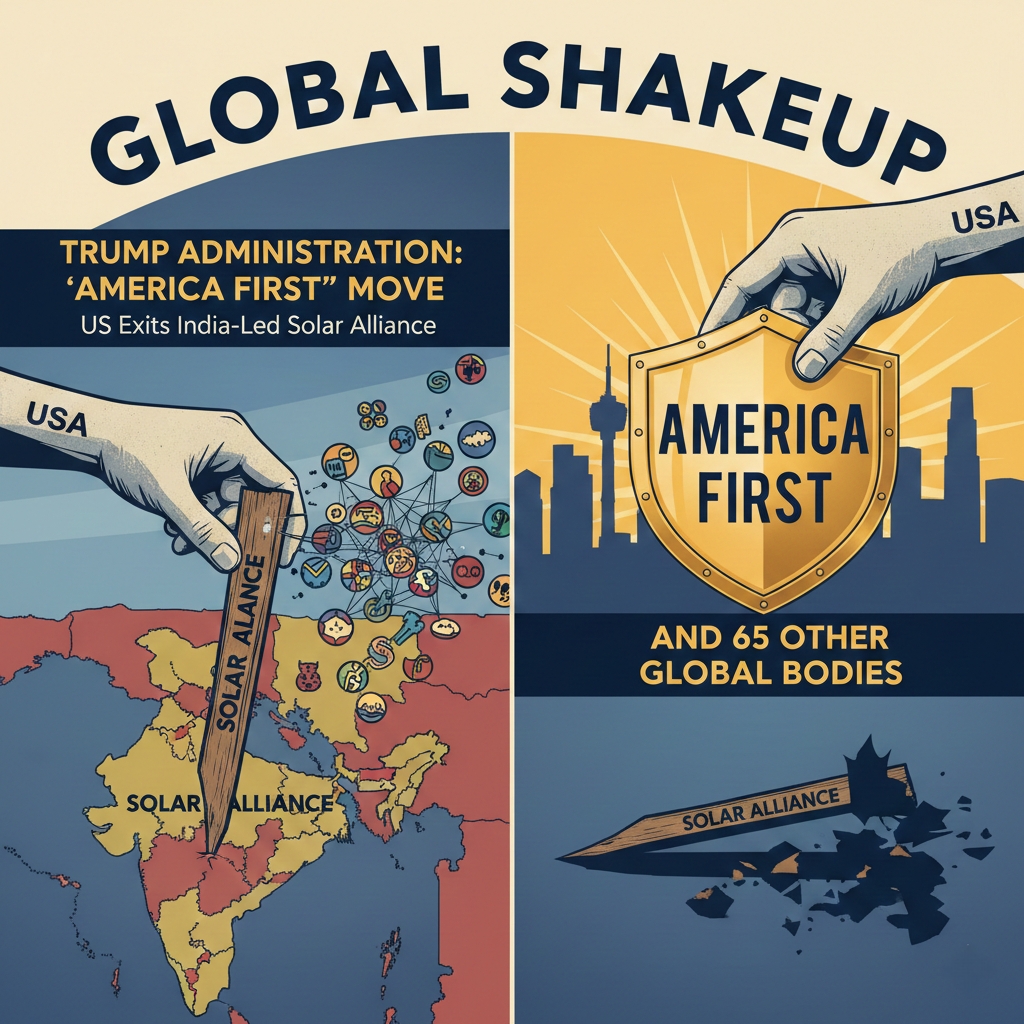
In a decisive assertion of its “America First” foreign policy, the Donald Trump administration has formally announced the United States’ withdrawal from 66 international organisations, including the India-led International Solar Alliance (ISA). The decision, disclosed by the US State Department on Tuesday, signals a major shift in Washington’s approach to multilateral cooperation—particularly in climate action and renewable energy.
According to the State Department, the exit was driven by misalignment with US national interests and what it described as disproportionate financial obligations. “These organisations no longer serve America’s priorities,” the statement said.
The International Solar Alliance, launched in 2015 by India and France on the sidelines of the Paris Climate Agreement, brings together over 120 countries with the goal of accelerating solar energy adoption, especially across developing nations. India currently chairs the alliance, leading initiatives focused on affordable solar technology, capacity building, and international financing.
This move mirrors former President Trump’s first-term decision to withdraw the US from the Paris Climate Agreement, reinforcing a broader retreat from global climate commitments. Alongside ISA, the US has also exited bodies such as the World Health Organization (WHO), UNESCO, and several UN-affiliated institutions.
Dr. Emily Carter, a climate policy expert at Stanford University, observed,“Although the US contribution to ISA was relatively modest—around $10 million annually—the withdrawal sends a powerful signal of disengagement from multilateralism, potentially opening space for other powers, particularly China, to expand their influence.
🌎”Implications for India and the Global Solar Push for India:
the US exit represents both a diplomatic and strategic challenge. As ISA chair until 2026, New Delhi has used the platform to mobilise nearly $2 billion in commitments for solar projects across Africa and South Asia.
Ajay Mathur, former Director General of ISA, warned,“This decision could slow funding flows and technology transfers that are crucial for achieving India’s ambitious target of 500 GW of renewable energy capacity by 2030.
”Economically, the move may impact US-India collaboration in solar manufacturing, an area where American companies such as First Solar have made significant investments. However, analysts believe India could compensate by deepening cooperation with the European Union, Japan, and other ISA members.
From an environmental perspective, the timing is critical. Global solar capacity expanded by 24% in 2025, according to IRENA, as countries raced to meet climate goals amid rising global temperatures. The US withdrawal risks undermining collective momentum in scaling clean energy solutions.Responding to the development, Indian Ministry of External Affairs spokesperson Randhir Jaiswal said,“India regrets the decision but remains fully committed to the mission and objectives of the International Solar Alliance. We also remain open to bilateral cooperation with the United States in the energy sector.
”The US decision underscores growing tensions around multilateralism versus unilateral national interests. As global reactions continue to emerge, a key question remains: Will this shift accelerate bilateral energy partnerships—or further fragment international climate efforts at a time when global cooperation is most needed?

If you’re feeling lucky Billionaire777vn might be your jam. It’s got that flashy, wealth-focused look that I dig. Worth a try if you think today’s your day to win big bucks. Check it out here: billionaire777vn